AI in Real Business Workflows
· Updated
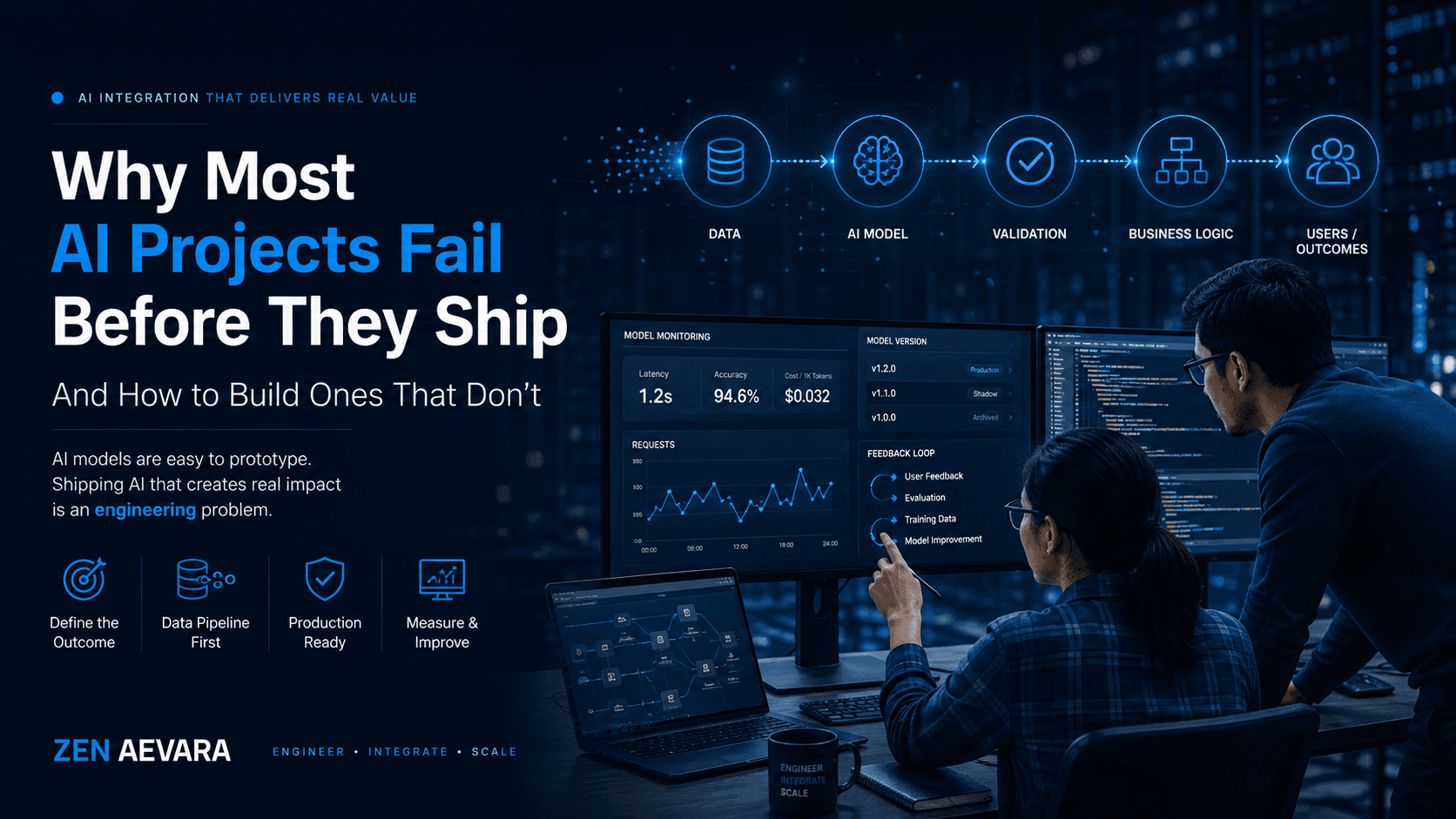
Why Most AI Projects Fail Before They Ship (And How to Build Ones That Don't) Every engineering team has seen it: months of AI experimentation that never becomes a working product. The model demos look great. The internal prototype runs. But it never makes it to users — or worse, it ships and delivers no measurable value. This isn't a model problem. It's an integration problem.
The Real Gap Is Between AI Capability and Product Reality AI models — whether large language models, classification engines, or recommendation systems — are tools. They don't inherently know your data schema, your user context, your latency requirements, or your business logic. Bridging that gap is where most AI projects quietly die. The teams that succeed treat AI as an engineering module, not a science experiment. That means defining the outcome first and selecting the model second. It means designing the data pipeline before tuning the model, setting performance benchmarks before declaring anything production-ready, and building observability so the model's behavior is auditable rather than opaque.
The Integration Patterns That Actually Hold Up The integrations that survive contact with production tend to follow recognizable patterns. Sometimes AI works best as a workflow accelerator — it doesn't replace the human step, it pre-processes, summarizes, or ranks so the human decision takes ten seconds instead of ten minutes. Document review, customer triage, and anomaly flagging all fit this cleanly. In other cases, AI serves as a data-to-action bridge, taking structured business data and surfacing clear recommendations instead of asking users to interpret dashboards on their own. And in the most seamless implementations, the AI is invisible entirely — powering a smarter search, a contextual suggestion, an auto-classification — without requiring the user to interact with "an AI" at all. These are the integrations that age well, because the user experience remains the constant.
What Good AI Engineering Actually Looks Like Production AI requires the same discipline applied to any production system: version control for prompts and models, regression testing for behavior changes, circuit breakers for API failures, and cost monitoring for token usage. It also requires a feedback loop — a mechanism for the system to improve over time based on real usage, not just initial training data. Without this, even a well-built AI integration drifts from what it was designed to do.
How ZENAEVARA Approaches AI Integration At ZENAEVARA, we treat every AI integration as a system design problem first. We don't ship models. We ship AI-enabled products — ones that handle edge cases, degrade gracefully, and deliver outcomes the business can measure. If your team has an AI use case you're unsure how to ship, that's exactly the conversation worth having."